Enterprise Cloud Migration Costs: Expense Factors, Budgeting, and ROI Calculation
A comprehensive financial guide for IT leaders detailing direct and indirect cloud migration costs, network egress fees, refactoring risks, and ROI frameworks across major cloud providers.
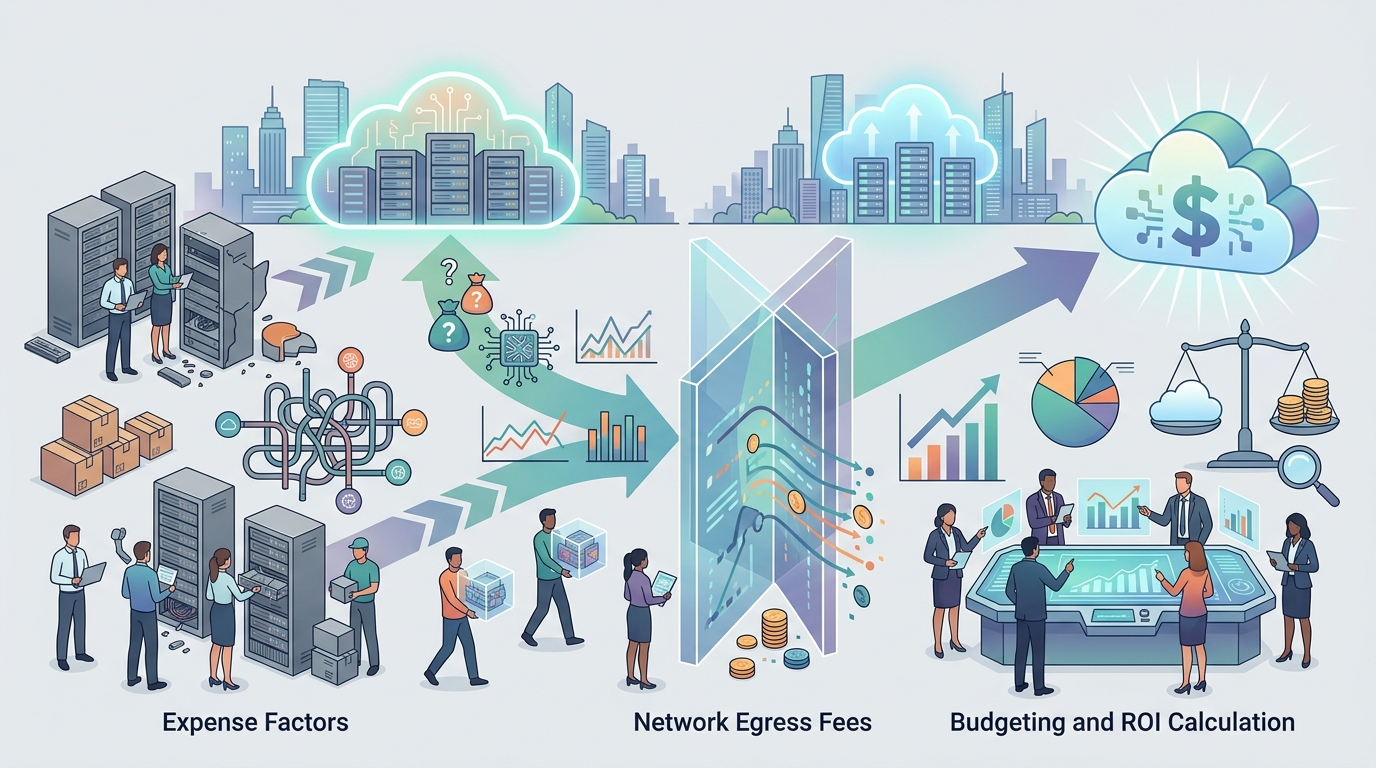
Transitioning an enterprise infrastructure from on-premises datacenters to public cloud platforms represents one of the largest capital and operational realignments an enterprise can undertake. While cloud computing offers flexibility, global scale, and access to advanced services, the financial journey is rarely straightforward. Organization leaders frequently discover that the total cost of migration extends far beyond basic compute and storage rental fees.
Understanding the Scope of Enterprise Cloud Migration Financials
Enterprise cloud adoption shifts corporate IT spending from a Capital Expenditure (CapEx) model—where infrastructure is purchased upfront and depreciated over several years—to an Operational Expenditure (OpEx) model driven by recurring utility-style consumption. In a traditional hardware environment, costs are static and predictable over three- to five-year lifecycles. In contrast, cloud environments introduce dynamic pricing where operational habits, architectural choices, and resource utilization directly impact monthly balance sheets.
A comprehensive cloud budget must account for three distinct phases: pre-migration preparation, the active migration phase (including temporary parallel operations), and long-term steady-state cloud operations. Neglecting any single phase can lead to significant budget overruns, unexpected double-spending, and delayed return on investment.
Direct vs. Indirect Costs in AWS, Azure, and GCP Deployments
Budgeting accurately requires separating direct line-item vendor expenses from internal, indirect operational expenses. Public cloud providers such as Amazon Web Services (AWS), Microsoft Azure, and Google Cloud Platform (GCP) publish baseline pricing schedules, but these cover only the direct cloud infrastructure components.
Direct costs represent the measurable services billed directly by cloud service providers. These include compute instances (such as AWS EC2, Azure Virtual Machines, or GCP Compute Engine), block and object storage resources, managed database services, software license fees, and enterprise-level technical support contracts.
Indirect costs are frequently understated during initial business case development. These expenditures stem from internal labor, operational disruption, and transition overhead necessary to execute the migration safely.
- Dual-Running Expenses: The cost of maintaining on-premises datacenters, hardware leases, and power contracts while concurrently paying for scaling cloud environments during the transition window.
- Staff Upskilling and Training: Educational programs, technical certifications, and third-party consulting fees needed to equip existing IT personnel with cloud-native engineering capabilities.
- Application Integration and Testing: Labor hours required to reconfigure application dependencies, rewrite legacy integrations, and perform security regression testing.
- Productivity Downtime: Planned or unplanned operational slowdowns during service cutovers and database sync operations.
Estimating Data Transfer Egress Fees and Network Infrastructure Upgrades
Data transfer economics represent one of the most volatile variables in cloud budgeting. Inbound data transfer (ingress) into public cloud platforms is generally free of charge. However, moving data out of cloud platforms (egress)—whether to return to on-premises systems, transfer to a secondary cloud provider, or deliver content to end users—incurs usage-based fees based on published bandwidth tier schedules.
Egress fees are structured on tiered volume schedules. Cloud providers typically charge a higher rate per gigabyte for the initial terabytes moved per month, with incremental rate discounts as data volumes scale into hundreds of terabytes. For data-intensive applications, unexpected egress volume can add thousands of dollars to monthly invoices.
Establishing reliable high-speed connections during and after migration requires dedicated network infrastructure. Dedicated cloud interconnections—such as AWS Direct Connect, Azure ExpressRoute, or GCP Cloud Interconnect—provide private, predictable network connectivity between enterprise facilities and cloud datacenters. These dedicated links reduce latency and lower per-gigabyte egress costs compared to standard internet routing, but they carry fixed monthly port charges and carrier circuit circuit expenses that must be budgeted.
Rehosting vs. Refactoring: Financial Risk and Cost Analysis
The migration architecture strategy selected for each application directly impacts both short-term implementation budgets and long-term operating efficiency. The two primary paths are rehosting (commonly called 'lift-and-shift') and refactoring (re-architecting for cloud-native design).
Rehosting moves applications to cloud virtual machines with minimal changes to underlying code or operational architecture. It offers the fastest path to datacenter evacuation and minimizes upfront engineering expenses. However, lift-and-shift applications rarely leverage cloud elasticity, resulting in oversized server instances and higher recurring monthly compute costs.
Refactoring involves rewriting applications to leverage serverless architectures, managed container platforms, and cloud-native databases. While refactoring requires significant upfront engineering investments and longer development timelines, it yields optimized operational costs, automatic scaling, and reduced technical debt over time.
| Migration Strategy | Upfront Engineering Cost | Ongoing Monthly OpEx | Technical Debt Level | Time to Complete |
|---|---|---|---|---|
| Rehosting (Lift-and-Shift) | Low to Moderate | Higher (Over-provisioned) | High (Legacy Unchanged) | Fast (Months) |
| Replatforming (Lift and Reshape) | Moderate | Moderate | Moderate | Moderate (6-12 Months) |
| Refactoring (Cloud-Native) | High to Very High | Optimized (Pay-per-use) | Low | Extended (12-24+ Months) |
Managing Ongoing OpEx Cloud Spend and Preventing Overruns
Without rigorous governance, cloud expenditure can rapidly exceed baseline forecasts. Cloud financial management—often structured around FinOps frameworks—combines financial accountability with cloud engineering practices to control variable operational spending.
Preventing cost overruns requires enforcing structured tagging policies, continuous monitoring, and automated guardrails across all cloud environments:
- Resource Tagging Frameworks: Mandating standardized metadata tags (such as Cost Center, Environment, Owner, and Application ID) on every deployed cloud resource to ensure exact operational cost allocation.
- Capacity Commitment Programs: Utilizing commitment options—such as AWS Savings Plans, Azure Reserved Instances, or GCP Committed Use Discounts—to secure rate reductions (often between 30% to 60%) in exchange for one- to three-year capacity commitments.
- Automated Orphan Resource Cleanup: Implementing automated tools to identify and delete unattached elastic block storage volumes, idle load balancers, and unassigned public IP addresses.
- Auto-scaling Policy Guardrails: Setting strict upper ceilings on automated scaling policies to prevent unexpected workload spikes or runaway compute processes from inflating monthly bills.
Security, Compliance, and Data Protection Expenses
Migrating sensitive corporate assets to shared cloud environments creates continuous regulatory compliance and security infrastructure costs. Federal Trade Commission (FTC) enterprise security guidance emphasizes that organizations must maintain rigorous data protection controls, explicit access restrictions, and active monitoring across all operational environments (Source 1).
Ensuring cloud compliance requires budgeting for specialized security tooling and administrative oversight. Common security and compliance line items include:
- Identity and Access Management (IAM): Implementation of granular, least-privilege role controls, multi-factor authentication infrastructure, and centralized identity directory synchronization.
- Data Encryption Infrastructure: Managed Key Management Service (KMS) modules to encrypt sensitive data both in transit across network boundaries and at rest within object storage and managed databases.
- Centralized Logging and SIEM Integration: Continuous audit logging, centralized security information and event management (SIEM) log ingestion, and real-time security threat detection tooling.
- Independent Audits and Compliance Testing: Third-party vulnerability scanning, penetration testing, and regulatory audit attestations (e.g., SOC 2, ISO 27001) designed to verify control efficacy.
Calculating Timeline to ROI for Enterprise Cloud Adoption
Calculating the timeline to achieve Return on Investment (ROI) requires balancing initial migration investments against recurring operational savings and legacy hardware cost avoidance. In traditional financial modeling, net benefits materialize as legacy equipment leases expire, datacenter footprints shrink, and operational efficiencies take effect.
The classic Net Present Value (NPV) framework incorporates four primary financial vectors: direct legacy capital expenditure avoidance, facility operational savings (power, cooling, rack space), cloud operational costs, and the amortized cost of the migration project itself.
| Year | Legacy On-Prem Spend Avoided | Cloud Infrastructure OpEx | Migration Project Capital Spend | Net Annual Cash Flow | Cumulative Net Value |
|---|---|---|---|---|---|
| Year 1 | Baseline Cost ($100%) | Cloud Compute + Dual-Run Spend | High (Services, Upskilling, Setup) | Negative (Investment Phase) | Negative Balance |
| Year 2 | Reduced On-Prem Spend | Full Steady-State Cloud OpEx | Low (Final Tail-end Cutover) | Neutral / Slightly Positive | Approaching Break-Even |
| Year 3 | Datacenter Fully Decommissioned | Optimized Cloud Spend (FinOps) | Zero (Project Complete) | Positive Operating Margin | Positive Cumulative ROI |
Enterprise migration projects typically reach breakeven between month 20 and month 36, depending on the speed of legacy datacenter decommissioning and the extent to which cost optimization practices are applied.
What are cloud network egress fees and why do they vary?
Egress fees are charges levied by cloud providers for moving data out of their networks to external locations or other cloud regions. Inbound data transfer is generally free, but outbound data transfer is billed on volume-tiered schedules published by each vendor.
How does lift-and-shift compare financially to application refactoring?
Lift-and-shift involves lower upfront engineering costs and faster cutover timelines, but yields higher ongoing monthly operating expenses because legacy software cannot take full advantage of cloud auto-scaling. Refactoring requires substantial upfront labor and longer implementation windows, but results in lower ongoing operating expenditures.
How long does it typically take an enterprise to achieve positive ROI from cloud migration?
Most enterprise cloud migration projects reach breakeven and positive cumulative ROI within 20 to 36 months, driven primarily by legacy hardware cost avoidance, datacenter lease termination, and automated resource management.
Sources
- Data Security and Tech Guidance for Business — Federal Trade Commission
This article is for general information only and is not professional advice. Figures come from public sources and change over time; check the official source before you act.
More from Daily Facts Wire
- 5 Lifeline Phone Application Mistakes That Stop Your Monthly Benefits
- 7 Income Rules That Qualify You for a Free Smartphone Today
- The 4.5GB Smartphone Data Secret Millions Miss Each Month
- Get Your Free Smartphone Through Federal Lifeline and Meta Promo Rules
- 4 Costly Mistakes People Make Claiming Free Phones On Facebook
- The $35 Hidden Activation Fee Inside Free Meta Phone Offers